Email: [email protected]
Email: [email protected]

Cabine de sablage de table : préparation de surface compacte pour ateliers
 Accueil / Nouvelles / Nouvelles de l'industrie / Cabine de sablage de table : préparation de surface compacte pour ateliers
  2026.07.31
 Nouvelles de l'industrie
Le cabine de sablage de table est devenu un outil de préparation de surface essentiel pour les ateliers, les petites installations de fabrication et les opérations de maintenance nécessitant un nettoyage, un ébavurage et une finition efficaces des pièces métalliques et plastiques. Cette armoire compacte comprend une chambre de travail scellée avec des gants intégrés et une fenêtre de visualisation, permettant aux opérateurs de diriger des produits abrasifs sur les pièces sans s'exposer à la poussière ou aux particules volantes. Des rapports récents de l'industrie indiquent que les cabines de sablage de table ont gagné en popularité dans les petits magasins en raison de leur prix abordable, de leur faible encombrement et de leur capacité à effectuer un large éventail de tâches de préparation de surface, notamment l'élimination de la rouille, le décapage de peinture et la texturation de surface. La conception compacte de l'armoire le rend adapté à une installation sur paillasse.
Le table sandblasting cabinet is constructed from heavy-gauge steel with a powder-coated finish that resists abrasion and corrosion, ensuring the cabinet maintains its appearance and structural integrity even with regular exposure to abrasive media. The cabinet features a large viewing window that provides a clear view of the work area, with the window protected by a replaceable film or glass shield that prevents scratching and extends service life. The cabinet includes built-in gloves that allow the operator to manipulate the workpiece and blast gun from outside the cabinet, with the gloves constructed from durable rubber or neoprene that provides flexibility and protection. The sealing system prevents abrasive media and dust from escaping, with the cabinet's door and seals designed to maintain a tight seal even with repeated use. The cabinet's robust construction ensures long service life.
Le table sandblasting cabinet includes a blasting system that delivers abrasive media to the workpiece with precise control, allowing operators to adjust the blasting pressure and media flow to suit different materials and surface preparation requirements. The blasting system includes a blast gun that directs the abrasive stream, a media feed hose that delivers media from the hopper to the gun, and a compressed air connection that provides the power for media acceleration. The media delivery system includes a siphon or pressure pot that feeds abrasive media to the blast gun, with the system designed to provide consistent media flow and prevent clogging. Key features of the blasting and media system include:
Le cabinet includes a media reclamation system that collects and recycles abrasive media, reducing operating costs and waste. The reclamation system includes a screen or separator that removes debris.
Le table sandblasting cabinet includes a dust collection system that maintains visibility and prevents dust accumulation during blasting operations. The dust collection system includes a dust collector or vacuum connection that removes dust and debris from the cabinet, with the system designed to maintain negative pressure inside the cabinet to prevent dust from escaping. The visibility features include a work light that illuminates the work area, with the light positioned to provide shadow-free illumination. The viewing window is designed to resist fogging. The work area includes a turntable or grate.
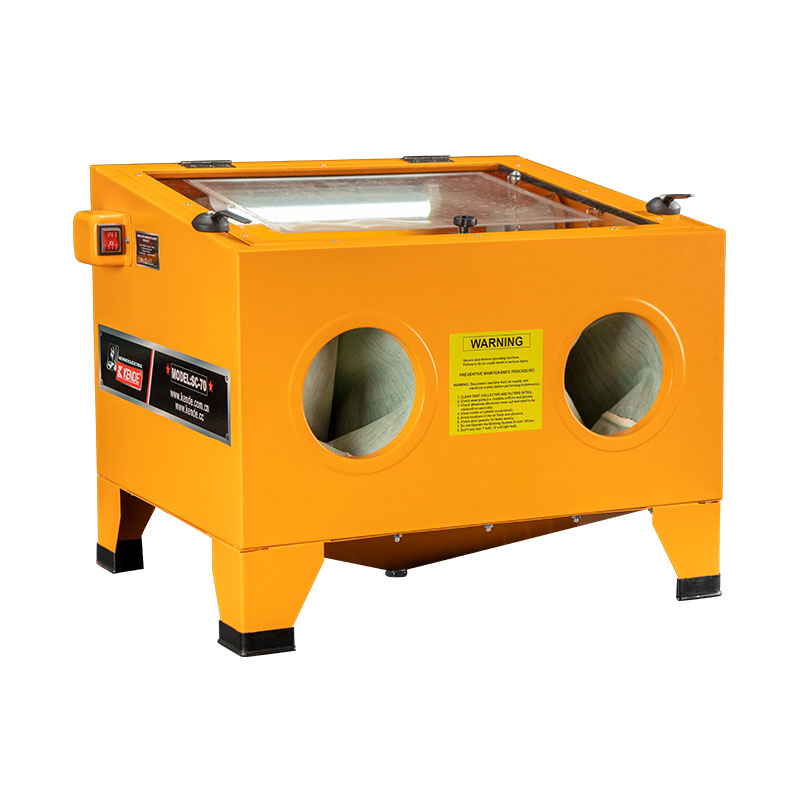
Le table sandblasting cabinet's work area is designed to accommodate a range of part sizes and shapes, with the turntable allowing rotation for even blasting coverage and the grate providing support for smaller parts. The work area dimensions determine the big workpiece size, with the cabinet's overall footprint dictating the installation requirements. The work area includes a built-in screen or grate that allows media to fall through for reclamation, with the screen designed to prevent large debris from entering the reclamation system. The work area is designed for easy cleaning, with the interior surfaces smooth and free from ledges.
Lors de la sélection d'une cabine de sablage de table, les acheteurs évaluent la qualité de la construction et de l'étanchéité de l'armoire, les performances du système de sablage et la distribution des médias, l'efficacité de la dépoussiérage et les caractéristiques de visibilité, ainsi que la taille de la zone de travail et les capacités de manipulation des pièces. La capacité de l'armoire à fournir une préparation de surface cohérente et efficace pour les pièces et applications spécifiques de l'utilisateur est la principale considération. Une sélection appropriée garantit une préparation de surface efficace pour une large gamme d'applications.
Produits recommandés

Contactez-nous
No.2299, Section de Luqiao, Avenue de Shugang, District de Luqiao, Taizhou, 318057 Zhejiang, RP Chine.
+86-576-82431568
 Confidentialité
 English
 中文简体
中文简体
 русский
 Español
 عربى
عربى
 Français
 Português
 Deutsch
 Український